
Traffic Warrants in Limestone County
The Limestone traffic court says a citation requires a response through District Court. Failure to appear, pay, or dispose of the ticket may result in an arrest warrant, an increased fine, bail forfeiture, and notice to the Alabama Law Enforcement Agency. The date printed on a ticket is not always a trial date. A person who wishes to plead not guilty or seek trial must follow the court's appearance directions.
A payable citation and a mandatory appearance are not interchangeable. Some tickets may be resolved through an authorized payment path. Others require court action. A ticket payment tool does not clear an unrelated criminal warrant, and driving school does not automatically recall a warrant. Confirm what the Limestone County traffic warrant requires before sending money or going to court.
Limestone Traffic Warrant Entry Delay
The Alabama Traffic Service Center payment page advises allowing up to ten business days for a citation to enter the system. An early “not found” response may mean the ticket has not yet been entered. It does not prove that the obligation disappeared or that no later warrant can issue.
The official payment instructions are shown below. They describe payment channels for a known citation, not a Limestone County traffic warrant search.
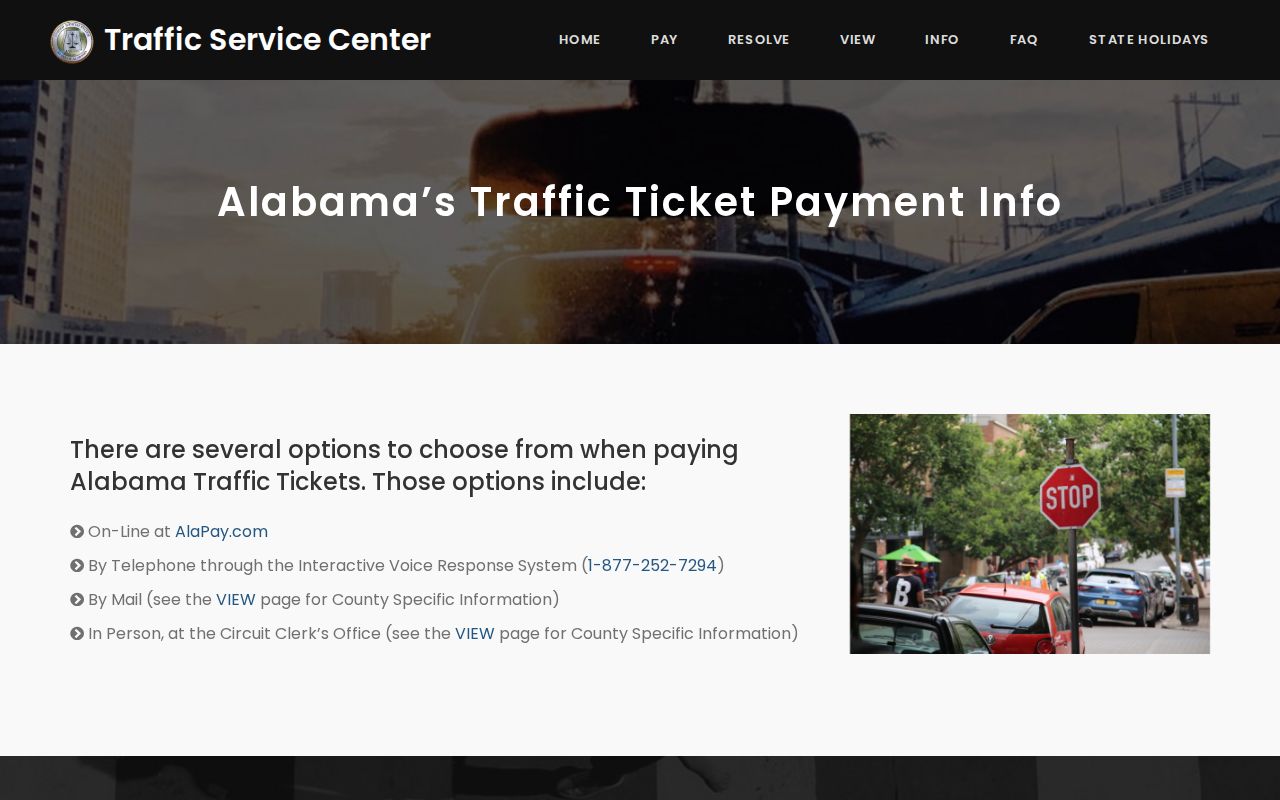
If the citation remains absent after the stated entry period, contact the Limestone County Circuit Clerk. Keep the ticket and note the UTC characters exactly.
How to Check for a Traffic Warrant
No public countywide traffic-warrant names list was located. The useful channels instead start with the known citation or court case. Use only your own details, or assist a relative with permission. The District Court and Circuit Clerk remain the sources for present warrant status.
- Use Resolve Alabama, AlaPay, or the Traffic Service Center for a known citation.
- Enter the UTC or case fields exactly and complete any identity check the official system requests.
- Call the Circuit Clerk at (256) 233-6406 if the entry is missing or status is unclear.
- For an Athens municipal ticket, contact Athens Municipal Court rather than assuming District Court holds it.
- For service routing, call the Sheriff at (256) 232-0111. Alabama has no public statewide warrant name search.
Limestone Traffic Warrant Fields
The official tools are built for a known ticket. AlaPay's ticket search asks for a UTC letter, seven-digit UTC number, birth month, and birth year. Its case path asks for county or municipality, division, year, case number, extension, and identity verification. Visible codes include 44 LIMESTONE, 93 ATHENS, and traffic division TR.
The AlaPay landing page is pictured below. It separates ticket, case, and balance workflows.
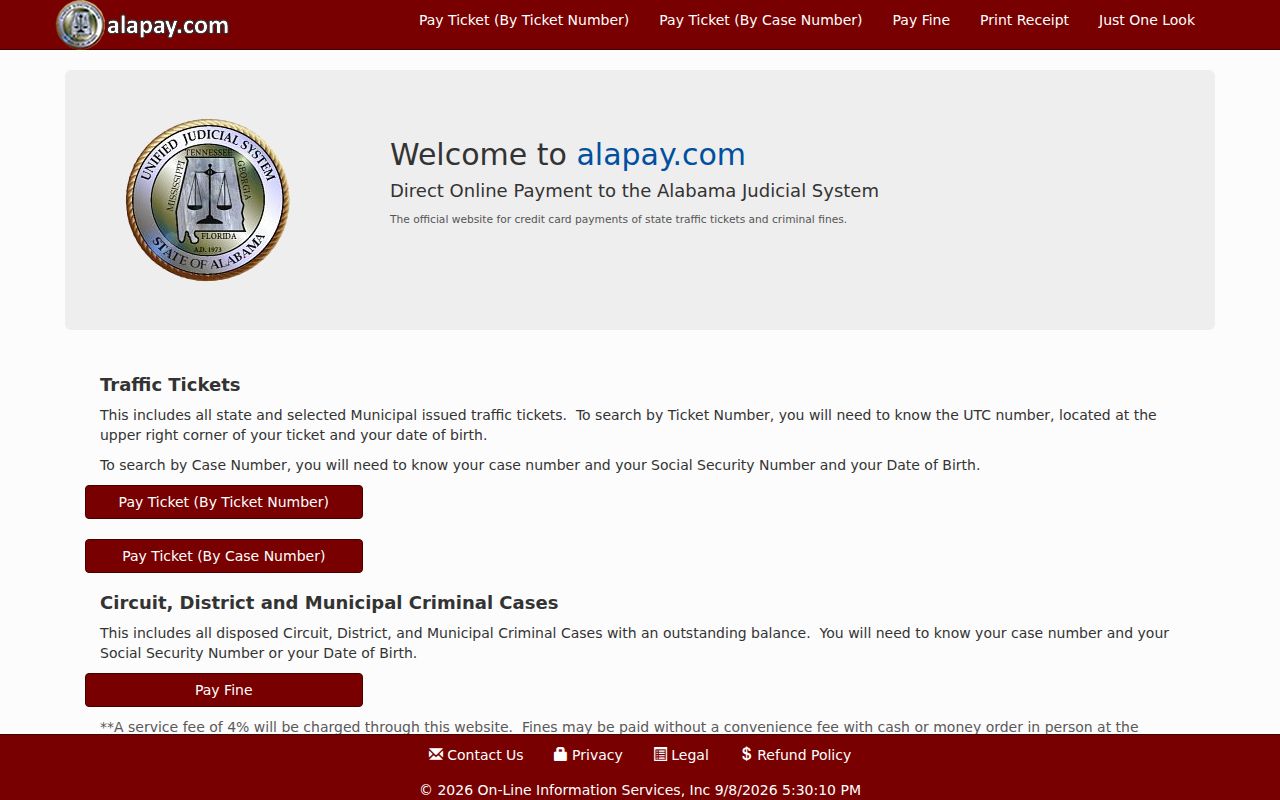
That separation matters. A balance or ticket result is not proof that a traffic warrant is active, recalled, or absent.
What a Traffic Warrant Shows
A court record may connect the citation, alleged offense, issuing court, money due, and status events. Read the issuing court first. A payment screen can show a payable balance without displaying the full Limestone County traffic warrant record, and a current clerk response may be newer than a portal result.
| UTC / Case Number | The ticket identifier or court case linkage, entered exactly as printed. |
|---|---|
| Charge / Offense | The cited traffic allegation; payment eligibility varies by charge. |
| Issuing Court | Limestone District Court or the municipal court that owns the citation. |
| Amount / Bond | The current court-set amount, which must be verified before payment. |
| Status Events | Payment, appearance, FTA, warrant, recall, or other docket activity when displayed. |
Limestone Traffic Warrant Channels
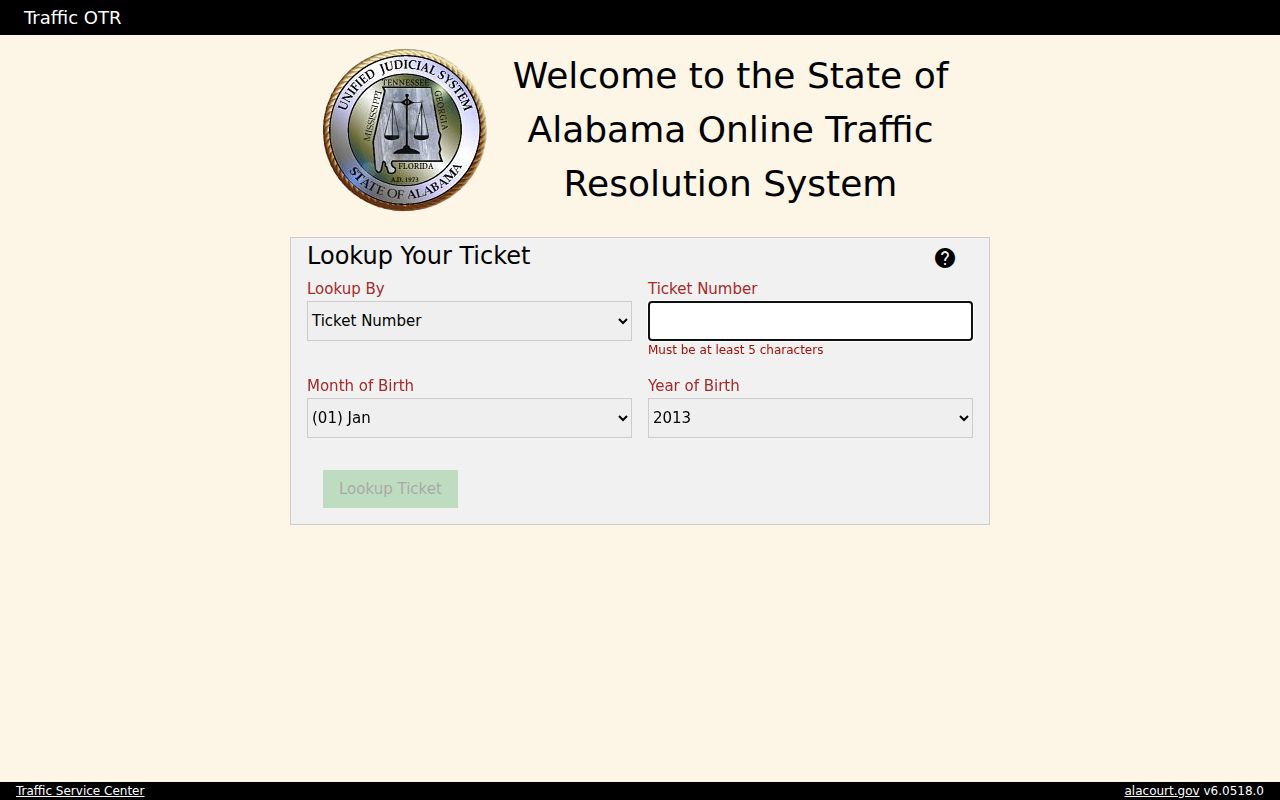
The Traffic Service Center offers online, mail, phone, and in-person routes. Its automated payment line is (877) 252-7294; general help is (866) 954-9399 or traffic@alacourt.gov. Limestone's court page also points to AlaPay and Resolve Alabama. Each is a citation service, not a general names search.
The official Resolve Alabama entry screen is shown here as one route for a known ticket.
Mail payment requires the signed guilty plea on the ticket and a money order or cashier's check sent to the District Court Clerk at 200 Washington Street, Athens. The local page does not accept personal checks. Follow the trial instructions when contesting the charge.
Paying or Lifting a Traffic Warrant
Payment is only one possible route. A person may need to appear, request trial, post bond, or complete another court-approved step. “Recall” means the court withdraws the warrant. Do not assume a payment is final until the issuing court confirms the warrant status and any separate state action.
- Confirm the ticket, warrant, issuing court, and current amount.
- Ask whether payment is permitted or an appearance is mandatory.
- Use only the official channel the court names, or follow bond and hearing instructions.
- Keep the receipt and ask when the docket will show recall or disposition.
- Ask ALEA whether a separate license reinstatement step remains.
Warning: A receipt alone does not prove recall. Confirm the court record and any separate ALEA license action after resolution.
Limestone Traffic Warrant School Limits
Limestone's official traffic page describes court-approved defensive driving at the Sheriff Rodeo Arena and a court-accepted virtual option. The in-person class is generally held on the second and fourth Tuesday evenings and carries a published $50 fee, but judge approval and identification are required. Dates, price, and eligibility can change.
Completion is not automatic warrant recall. The certificate must reach the clerk or office of traffic resolution as instructed. Ask the court whether the class applies to the ticket, whether another appearance is due, and whether a Limestone County traffic warrant already issued. This is a court-disposition option, not a driving-history product.
Note: Verify the current schedule and obtain court permission before attending or paying for any program.
Traffic Warrant vs FTA and License Holds
One missed traffic obligation can create linked but separate records. Alabama's official form calls an FTA instrument an “alias warrant of arrest for failure of defendant to appear,” often shortened to bench warrant. ALEA may also receive notice affecting the license. Clearing one item does not silently clear the others.
| Mechanism | What Triggers It | What It Does |
|---|---|---|
| Traffic warrant | Unresolved citation or court order | Authorizes arrest under the court instrument |
| Failure to appear | A required setting was missed | Creates an FTA event and may lead to an alias warrant |
| ALEA license action | The court reports qualifying noncompliance | Affects driving privilege until state requirements are met |
Check the warrant with the court, the docket with the clerk, and the license consequence with ALEA. These are distinct official channels. For broader steps, see Limestone County warrant search.
Limestone Traffic Warrant Aftercare
Save the final payment receipt, appearance record, bond paper, and any order recalling the Limestone County traffic warrant. Then ask when the clerk expects the docket to update. If the court sent an FTA notice to ALEA, ask what proof or reinstatement step the state agency still requires. The court action and license action may update on different schedules.
If a portal still shows an old balance or status, do not make a second payment without checking. Give the clerk the receipt number and date, and request the correct official route for a record correction. A portal snapshot may lag the court's most recent order. Keep proof until both the case record and any separate state consequence are settled.
A missed deadline deserves a direct call even when the online ticket screen is unavailable. Ask whether the citation remains payable, whether a court appearance has become mandatory, and whether a warrant or bail-forfeiture entry exists. If counsel is involved, share the same ticket and court details with that lawyer. This focused check avoids mixing a Limestone District Court traffic matter with an Athens municipal ticket or an unrelated criminal case.